I Believe in One God by Ratzinger XVI Benedict
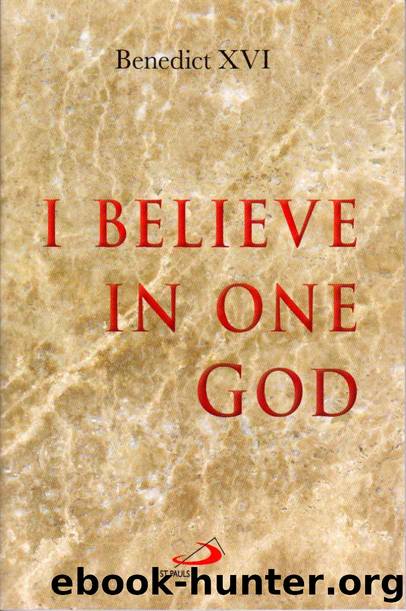
Author:Ratzinger XVI, Benedict
Language: eng
Format: epub
Tags: ebook, book
Publisher: ST PAULS / Alba House
Published: 2013-01-01T00:00:00+00:00
Eucharistic community
Through the sacrament of the Eucharist Jesus draws the faithful into his âhour;â he shows us the bond that he willed to establish between himself and us, between his own person and the Church. Indeed, in the sacrifice of the Cross, Christ gave birth to the Church as his Bride and his body. The Fathers of the Church often meditated on the relationship between Eveâs coming forth from the side of Adam as he slept (cf. Gen 2:21-23) and the coming forth of the new Eve, the Church, from the open side of Christ sleeping in death: from Christâs pierced side, John recounts, there came forth blood and water (cf. Jn 19:34), the symbol of the sacraments1. A contemplative gaze âupon him whom they have piercedâ (Jn 19:37) leads us to reflect on the causal connection between Christâs sacrifice, the Eucharist and the Church. The Church âdraws her life from the Eucharistâ2. Since the Eucharist makes present Christâs redeeming sacrifice, we must start by acknowledging that âthere is a causal influence of the Eucharist at the Churchâs very originsâ3. The Eucharist is Christ who gives himself to us and continually builds us up as his body. Hence, in the striking interplay between the Eucharist which builds up the Church, and the Church herself which âmakesâ the Eucharist4, the primary causality is expressed in the first formula: the Church is able to celebrate and adore the mystery of Christ present in the Eucharist precisely because Christ first gave himself to her in the sacrifice of the Cross. The Churchâs ability to âmakeâ the Eucharist is completely rooted in Christâs self-gift to her. Here we can see more clearly the meaning of Saint Johnâs words: âhe first loved usâ (1 Jn 4:19). We too, at every celebration of the Eucharist, confess the primacy of Christâs gift. The causal influence of the Eucharist at the Churchâs origins definitively discloses both the chronological and ontological priority of the fact that it was Christ who loved us âfirst.â For all eternity he remains the one who loves us first.
The Eucharist is thus constitutive of the Churchâs being and activity. This is why Christian antiquity used the same words, Corpus Christi, to designate Christâs body born of the Virgin Mary, his eucharistic body and his ecclesial body.5 This clear datum of the tradition helps us to appreciate the inseparability of Christ and the Church. The Lord Jesus, by offering himself in sacrifice for us, in his gift effectively pointed to the mystery of the Church. It is significant that the Second Eucharistic Prayer, invoking the Paraclete, formulates its prayer for the unity of the Church as follows: âmay all of us who share in the body and blood of Christ be brought together in unity by the Holy Spirit.â These words help us to see clearly how the res of the sacrament of the Eucharist is the unity of the faithful within ecclesial communion. The Eucharist is thus found at the root of the Church as a mystery of communion6.
Download
This site does not store any files on its server. We only index and link to content provided by other sites. Please contact the content providers to delete copyright contents if any and email us, we'll remove relevant links or contents immediately.
Professional Troublemaker by Luvvie Ajayi Jones(29668)
Empire of the Sikhs by Patwant Singh(23089)
Twilight of the Idols With the Antichrist and Ecce Homo by Friedrich Nietzsche(18638)
Plagued by Fire by Paul Hendrickson(17416)
The Sun and Her Flowers by Rupi Kaur(14526)
Norse Mythology by Gaiman Neil(13372)
A Journey Through Charms and Defence Against the Dark Arts (Harry Potter: A Journey Throughâ¦) by Pottermore Publishing(9276)
Fangirl by Rainbow Rowell(9259)
Adultolescence by Gabbie Hanna(8929)
Wonder by R.J. Palacio(8584)
Tools of Titans by Timothy Ferriss(8402)
Becoming Supernatural by Dr. Joe Dispenza(8223)
How to Bang a Billionaire by Alexis Hall(8160)
Wonder by R. J. Palacio(8115)
Crystal Healing for Women by Mariah K. Lyons(7933)
The Road Less Traveled by M. Scott Peck(7605)
The Lost Art of Listening by Michael P. Nichols(7507)
The Witchcraft of Salem Village by Shirley Jackson(7277)
The Institute by Stephen King(7043)
